


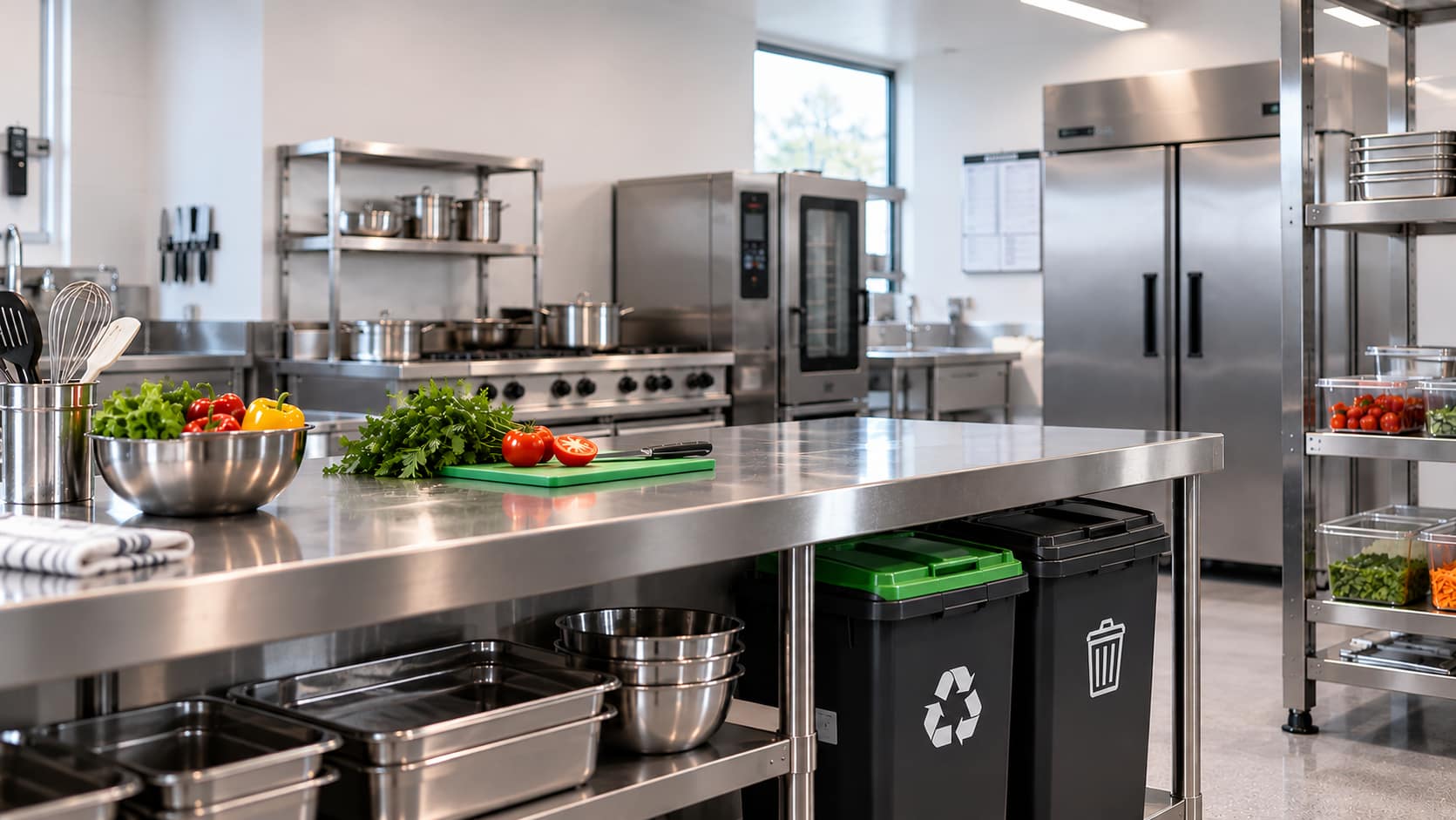
Sustainable Kitchen Design Ideas to Save Energy and Reduce Waste
Every design decision in your commercial kitchen affects how much energy you burn, how much water you waste, and how long your fitout actually lasts. Most kitchens get this wrong — they prioritise upfront cost, install materials that degrade fast, and end up replacing everything within five years.
A truly sustainable commercial kitchen is designed to last decades. Here is exactly how to do it.
Quick Answer – What Makes a Kitchen Eco Friendly in 2026?
Sustainability in commercial kitchens is not a trend, it is an operational advantage.
Kitchens that use durable materials and efficient layouts cost less to run, pass inspections faster, and require far fewer replacements.
Eco-friendly kitchens have:
- Long-life, recyclable materials
- Energy-efficient appliances
- Water-saving fixtures with a minimum 3-Star WELS rating
- Easy-clean, low maintenance surfaces
- Smart storage and waste separation
- Sustainable lighting and ventilation
Why Stainless Steel Is the Most Sustainable Commercial Kitchen Material?
Brayco has supplied stainless steel to Australian commercial kitchens for over 20 years. The pattern is consistent: kitchens that invest in quality 304-grade stainless from day one replace their benches and shelving far less frequently than those that cut corners on materials.
Stainless steel kitchen products:
- Are 100% recyclable without any loss of quality
- Are easy-clean and are non-porous, eliminating bacteria growth
- Support weight without sagging or bending
- Don’t chip, swell or peel; maintaining the original clean aesthetic
- Don’t degrade over time
- Are resistant to heat, fire, corrosion and moisture
- Can be reconfigured and relocated, eliminating the need for replacements when needs change
- Are timeless and versatile
Thoughtful kitchen design will maximise natural light, reducing the need for high energy consuming artificial lighting. Stainless steel reflects light, creating a brighter workspace without needing to flick a switch.
Brayco stainless steel benches and cabinets create a sleek aesthetic appeal using eco friendly materials; whether your undertaking a kitchen renovation or building your sustainable kitchen from scratch.
Bench Depth: Give Your Prep Area Room to Work
Bench depth might not immediately sound like a sustainability decision, but good workspace design can help you make better use of the equipment you already have. A deeper work surface provides additional room for food preparation, appliances, containers and ingredients without necessarily requiring another standalone work surface.
Brayco’s 914mm deep bench range provides additional working depth for commercial kitchens where a standard-depth bench doesn’t offer enough preparation space. Depending on your kitchen layout, that extra depth can help reduce equipment crowding and create a cleaner, more organised workflow.
A modular approach allows you to select the dimensions that best suit your kitchen, workflow and available space. Brayco offers modular ranges in 450 mm, 610 mm and 700 mm depths, helping you create practical work areas without adding unnecessary equipment or using more floor space than required. These modular options are available across sinks, benches and splashbacks, making it easier to coordinate different parts of your kitchen and adapt the layout as your operation changes.
The important thing is to choose bench dimensions based on how your kitchen actually operates rather than simply filling the room with as much equipment as possible.
Create Low-Waste Food Preparation Zones
Prep areas take some of the hardest wear in a commercial kitchen.
They’re regularly exposed to food, liquids, heat, heavy equipment and constant cleaning.
Fragile or unsuitable surfaces can suffer from:
- Cuts and surface damage
- Food staining
- Heat damage
- Moisture entering joins
- Chipping or peeling
- Difficult-to-clean gaps
Stainless steel provides a smooth, non-porous work surface that doesn’t absorb food particles or moisture and can withstand the demands of regular commercial food preparation when properly maintained. It also makes it easier to keep preparation areas clean without relying on delicate coatings or finishes.
Choose Water-Saving Sinks, Tapware and Plumbing
Water efficiency should be considered from the beginning of a commercial kitchen fitout, not after the plumbing has already been installed. The Water Services Association of Australia has highlighted the significant amount of drinking water lost through leaks and infrastructure inefficiencies across Australia.
Within your kitchen, there are several practical ways to reduce unnecessary water use.
Consider:
- WELS-rated tapware to reduce water consumption
- Aerated or spray tap designs that provide effective washing while controlling flow
- Sensor-operated taps where appropriate
- Well-proportioned sinks that suit the equipment being washed
- Integrated stainless steel sinks that minimise unnecessary gaps and joins
- Accessible plumbing so leaks can be identified and repaired quickly
Brayco offers stainless steel sinks and sink benches in a range of configurations, including single, double and triple-bowl options.
FAQs: Sustainable Commercial Kitchen Design
Is a sustainable commercial kitchen more expensive upfront?
It can be, depending on the materials and equipment selected. However, purchase price is only one part of the equation. Durable equipment that requires fewer replacements, energy-efficient appliances, reduced water consumption and repairable or reconfigurable equipment can all reduce costs over the life of the kitchen.
What grade of stainless steel should I use in a commercial kitchen?
304-grade stainless steel is commonly used in commercial kitchens due to its durability and excellent corrosion resistance. Different environments may require different grades, so it’s important to consider how and where the equipment will be used.
Brayco has been supplying commercial stainless steel equipment for over 20 years, and we use 304-grade stainless steel for our benchtops because we believe quality shouldn’t be compromised for price.
Not sure what separates the different grades? Read our guide to 304 vs 430 stainless steel.
Does stainless steel work in small commercial kitchens?
Absolutely. Modular stainless steel equipment can be particularly useful in small kitchens because benches, shelves and storage can be selected around the available footprint.
Using wall-mounted and under-bench storage can also help maximise usable space without overcrowding the kitchen.
How does open shelving help reduce food waste?
Visibility. When staff can see what’s available, it’s easier to rotate stock, identify ingredients approaching their use-by dates and avoid ordering products you already have. Open shelving can be particularly effective when combined with clearly labelled containers and FIFO stock rotation.
Can an existing commercial kitchen be made more sustainable?
Yes. You don’t necessarily need to replace your entire kitchen. Start with practical upgrades such as LED lighting, water-efficient tapware, better waste separation, improved shelving and stock rotation, repairing existing equipment and replacing inefficient appliances when they reach the end of their useful life.
In many cases, keeping and improving equipment that’s still fit for purpose is more sustainable than replacing everything simply to create a “green” kitchen.
Build a Kitchen That Lasts
The most sustainable commercial kitchen isn’t necessarily the one with the most eco labels. It’s the one that’s designed properly from the beginning.
Choose durable materials. Create an efficient workflow. Reduce unnecessary water and energy consumption. Make stock visible. Maintain what you already own. And choose equipment that can adapt as your business changes.
A commercial kitchen is a significant investment. Designing it to last means less waste, fewer replacements and a workspace that continues to perform for years to come.
Explore Brayco’s range of stainless steel benches, sinks, shelving and cabinets to start planning your commercial kitchen.